The War of the Worlds Panic: What Really Happened in 1938
Did Orson Welles’s 1938 Martian invasion broadcast send America into mass panic? What happened that night, and why historians say the panic was overblown.

In 1835, a New York paper claimed a famous astronomer had seen winged people on the Moon. The story of the Great Moon Hoax and why readers fell for it.
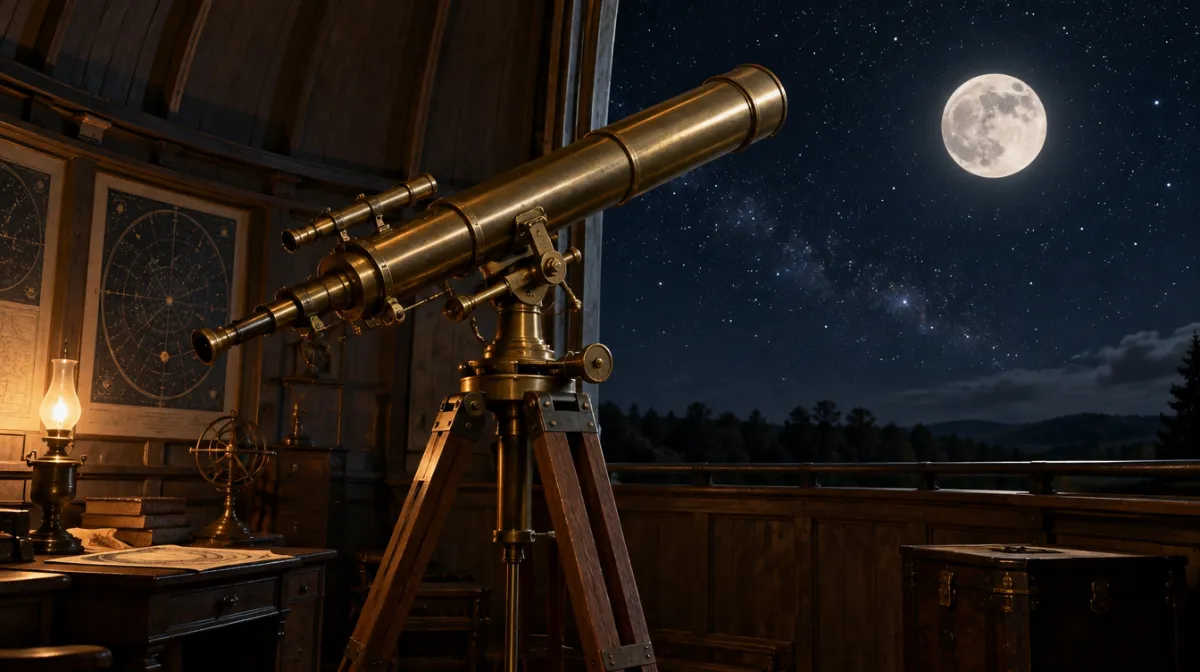
On August 25, 1835, readers of The Sun, a cheap New York daily, opened their papers to astonishing news. The celebrated British astronomer Sir John Herschel, working at the Cape of Good Hope with a powerful new telescope, had seen life on the Moon: forests, lakes, strange animals and, eventually, winged people. Over six installments, the story became one of the most famous newspaper hoaxes in history.
The series claimed to be reprinted from a supplement to the Edinburgh Journal of Science, which in fact had stopped publishing. It described:
| Factor | Why it helped |
|---|---|
| A real scientist | Herschel was genuinely in South Africa studying the southern skies, and out of contact |
| Scientific detail | Technical descriptions of optics and lenses sounded authoritative |
| A fake source | Attributing it to a respected journal added credibility |
| Serialization | Each installment added wonders, keeping readers hooked |
| The penny press | Cheap papers reached a huge new audience hungry for sensational stories |
Not everyone was fooled; rival papers and skeptics soon cried hoax. But many readers were delighted, whether they believed it or not, and The Sun’s circulation soared.
The hoax is usually credited to Richard Adams Locke, a writer at The Sun. Motives are debated: sales were certainly one, and some historians see the series as satire aimed at popular writers who claimed the Moon and planets must be inhabited. Edgar Allan Poe, who had recently published a story about a balloon voyage to the Moon, complained that his idea had been borrowed.
Within weeks, the hoax was widely recognized. The Sun never issued a full retraction; instead, it later mused about whether the story was true. Herschel himself reportedly found it amusing at first, though he grew tired of questions about it for years.
The story’s telescope was pure fiction: no lens could magnify the Moon enough to see animals, and Earth’s atmosphere blurs fine detail. For the real physics of how lenses bend light, Phyclub explains refraction and Snell’s law.
The Great Moon Hoax showed how easily a confident, detailed story could spread when it appeared in print, long before radio or the internet. A century later, the War of the Worlds broadcast became another media event whose impact grew in the retelling. For hoaxes involving physical objects rather than newsprint, see the Cardiff Giant.
Some readers did, at least briefly. Many others enjoyed the story as entertainment, and skeptics spotted it quickly.
No. The paper faced little lasting damage and gained many readers.
No. Herschel was a real, respected astronomer, but he had nothing to do with the articles.

Every article is edited by a human and checked against our editorial policy. Spotted a mistake? Tell us.
Did Orson Welles’s 1938 Martian invasion broadcast send America into mass panic? What happened that night, and why historians say the panic was overblown.
How pop duo Milli Vanilli became one of the biggest acts of 1989 without singing on their records, how the truth came out and why their Grammy was withdrawn.
In 1985 Coca-Cola replaced its 99-year-old formula and faced a revolt. The story of New Coke: the Pepsi Challenge, the taste tests and the 79-day U-turn.