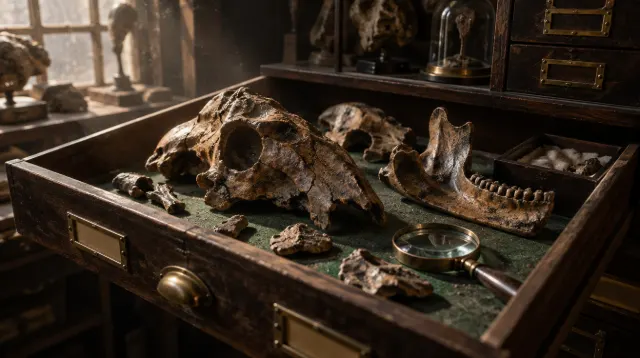
The Piltdown Man Hoax: How a Fake Fossil Fooled Science for 40 Years
In 1912 a skull from an English gravel pit was hailed as a missing link. In 1953 it was exposed as a forgery. How Piltdown Man fooled experts, and who did it.

In 1869, well diggers in New York found a 10-foot “petrified giant.” The story of the stone hoax that fooled crowds and sparked a feud with P.T. Barnum.
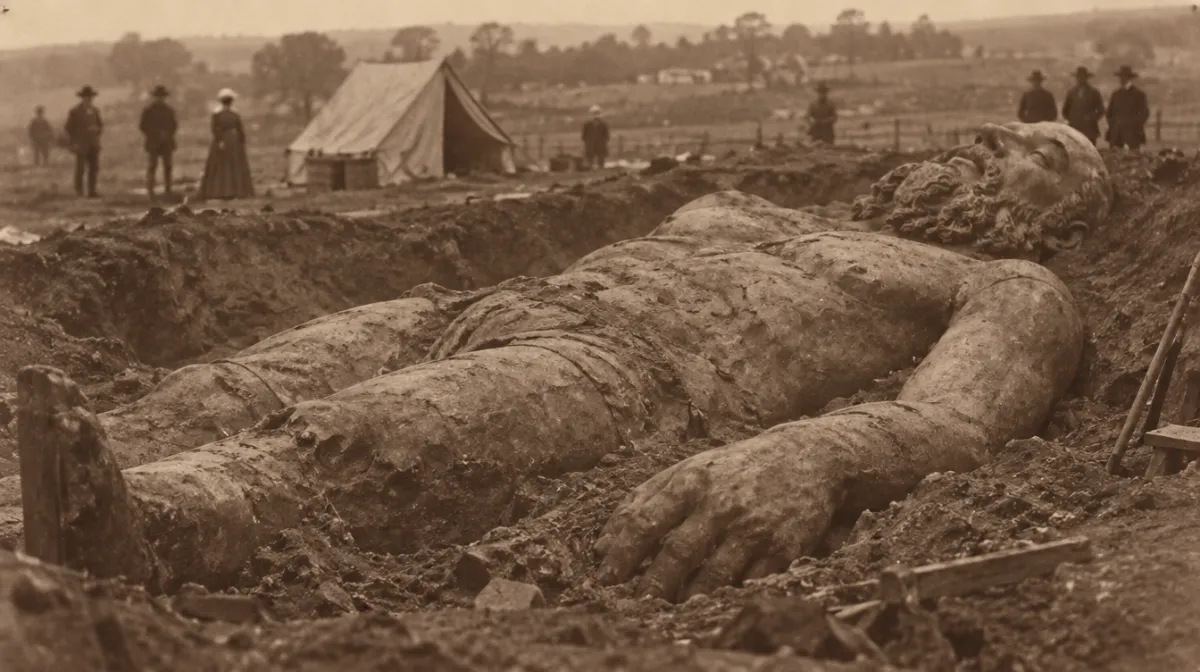
On October 16, 1869, two workers digging a well on William “Stub” Newell’s farm in Cardiff, New York, struck something hard. It was a stone foot. Within hours, they had uncovered a 10-foot-tall man, apparently turned to stone. Within days, thousands of people were paying to see him. The Cardiff Giant was one of the most successful hoaxes in American history.
The man behind the giant was George Hull, a cigar maker from Binghamton, New York, and Newell’s relative. According to his later account, Hull came up with the idea after arguing with a preacher about a passage in Genesis saying there were giants on the earth in ancient times. He wanted to show how easily people would believe.
In 1868, Hull bought a large block of gypsum in Iowa and had it shipped to Chicago, where stonecutters carved it into a reclining man. He aged the figure with acid and tools to mimic weathering and pores, then shipped it to Newell’s farm and buried it. A year later, Newell hired the unsuspecting well diggers.
| Date | Event |
|---|---|
| October 16, 1869 | The giant is “discovered” on Newell’s farm |
| Late October 1869 | Crowds pay to view it; a group of businessmen buys a share for a large sum |
| November 1869 | Paleontologist Othniel C. Marsh calls it “a most decided humbug” |
| Late 1869 | P.T. Barnum displays a copy in New York |
| December 1869 | Hull confesses |
Newell put up a tent and charged admission. Visitors debated whether it was a petrified human, an ancient statue or a fake. Some clergy and visitors embraced it as evidence of biblical giants; geologists and scientists were far more skeptical. Fresh chisel marks and the soft, soluble gypsum were clear signs of a recent carving.
The showman P.T. Barnum reportedly offered a large sum to rent the giant. When he was turned down, he had his own replica made and exhibited it in New York, claiming his was the real one and the other a fake. For a while, crowds in New York paid to see Barnum’s copy while the “original” toured nearby.
The phrase “There’s a sucker born every minute” is often linked to this episode and credited to Barnum, but there’s no good evidence he said it. Some accounts attribute it to one of the giant’s owners; its true origin is uncertain.
Under growing pressure, Hull admitted the hoax in December 1869. A court case over Barnum’s copy went nowhere, reportedly because it was hard to sue someone for calling a fake giant a fake. Hull had made a healthy profit, and the giant kept touring as a curiosity.
Today the original Cardiff Giant is displayed at The Farmers’ Museum in Cooperstown, New York, and Barnum’s copy survives too.
The giant offered something for everyone: religious confirmation, scientific mystery and a good day out. As with the Piltdown Man decades later, it also told some people exactly what they wanted to believe. For another case of the press and public being fooled on a grand scale, see the Great Moon Hoax of 1835.
Gypsum, a soft mineral that can be carved easily. Its softness was one of the clues that it wasn’t an ancient fossil.
There’s no reliable evidence he did. The line is linked to the Cardiff Giant story, but its origin is uncertain.
The original is on display at The Farmers’ Museum in Cooperstown, New York.

Every article is edited by a human and checked against our editorial policy. Spotted a mistake? Tell us.
In 1912 a skull from an English gravel pit was hailed as a missing link. In 1953 it was exposed as a forgery. How Piltdown Man fooled experts, and who did it.
In 1983, Stern announced it had found Hitler’s secret diaries. How a forger fooled editors and a famous historian, and how the fakes were exposed in days.
In 1985 Coca-Cola replaced its 99-year-old formula and faced a revolt. The story of New Coke: the Pepsi Challenge, the taste tests and the 79-day U-turn.