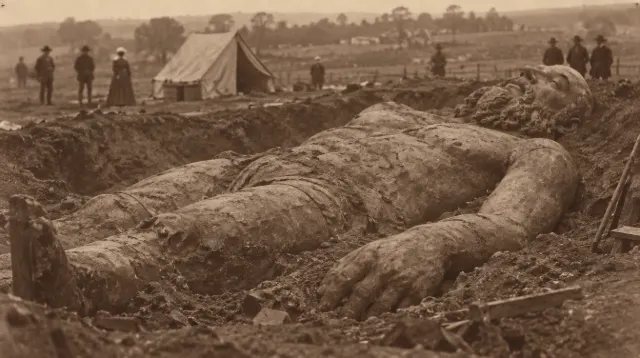
The Cardiff Giant Hoax
In 1869, well diggers in New York found a 10-foot “petrified giant.” The story of the stone hoax that fooled crowds and sparked a feud with P.T. Barnum.

In 1912 a skull from an English gravel pit was hailed as a missing link. In 1953 it was exposed as a forgery. How Piltdown Man fooled experts, and who did it.
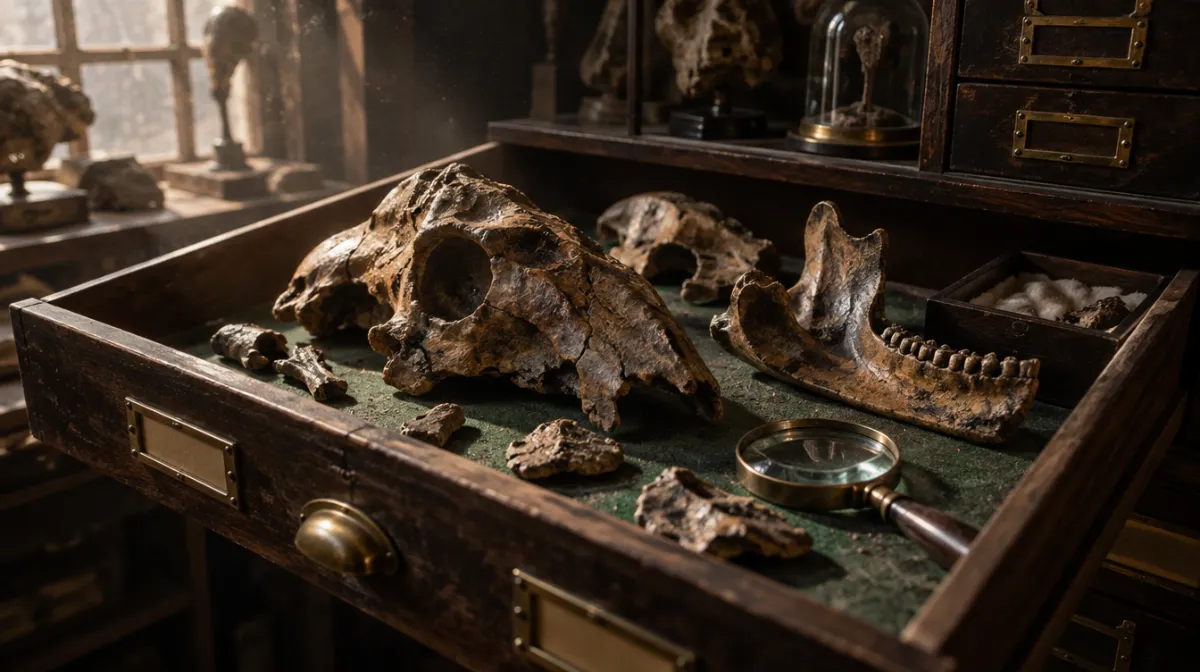
For four decades, one of the most celebrated fossils in the world was a fake. Piltdown Man, supposedly an early human ancestor dug out of an English gravel pit, appeared in textbooks and museum displays, and shaped how scientists thought about human evolution. In 1953 it was exposed as one of the most successful scientific frauds ever carried out. It wasn’t the first fake “ancient” find to fool the public: the Cardiff Giant drew paying crowds in 1869.
In 1912, Charles Dawson, a solicitor and keen amateur fossil hunter, reported finding pieces of a skull in a gravel pit near Piltdown in East Sussex. He brought the finds to Arthur Smith Woodward, keeper of geology at the British Museum (Natural History).
Further digging produced more fragments, animal fossils, flint tools and, crucially, part of a jawbone. In December 1912, Woodward and Dawson presented their reconstruction to the Geological Society of London: a creature with a large, human-like braincase and an ape-like jaw. They named it Eoanthropus dawsoni, “Dawson’s dawn man”.
More finds followed, including a canine tooth in 1913 and, later, fragments from a second site nearby.
Piltdown Man told many scientists exactly what they expected to hear.
The fossil record didn’t cooperate. In 1924, Raymond Dart described the Taung Child from South Africa, a small-brained creature with human-like teeth: the opposite pattern to Piltdown. As more genuine fossils emerged across Africa and Asia, Piltdown looked increasingly like an odd one out.
In 1949, Kenneth Oakley of the Natural History Museum applied a new technique, fluorine absorption dating. Buried bones slowly absorb fluorine from groundwater, so older bones contain more. The Piltdown bones contained surprisingly little. They were not nearly as old as claimed.
In 1953, Joseph Weiner, Kenneth Oakley and Wilfrid Le Gros Clark published proof that Piltdown Man was a deliberate fake.
| Element | What it really was |
|---|---|
| Skull fragments | Human, and relatively recent: medieval rather than prehistoric |
| Jawbone | From an orangutan |
| Teeth | Filed down to look human-like |
| Colouring | Stained with chemicals to match the gravel |
| Animal fossils and tools | Planted from other sites; one bone “tool” was carved with a metal blade |
Over the years, suspicion fell on almost everyone connected to the site, including the young priest and palaeontologist Pierre Teilhard de Chardin, museum staff and even Sir Arthur Conan Doyle, who lived nearby.
The strongest case has always been against Dawson himself. He was present at every important find, the discoveries stopped after his death in 1916, and later investigations found that many other antiquities he had “discovered” were also suspect.
In 2016, a team led by Isabelle De Groote used DNA analysis and CT scanning to re-examine the remains. They concluded that the specimens were prepared in a consistent way, pointing to a single forger, and that the evidence best fits Dawson.
Piltdown is often told as a story of science failing. It is also a story of science correcting itself. The hoax lasted because it matched expectations and because the original evidence was hard to examine. It collapsed when new methods and new fossils made it impossible to ignore.
The same weaknesses have been exploited ever since, from the forged Hitler Diaries in 1983 to the fakes of today. The tools are different, but the lesson — be most careful with evidence that tells you what you already want to believe — hasn’t changed, as investors in Theranos found out.
About 41 years, from its presentation in December 1912 to its exposure in 1953.
Fragments of a relatively recent human skull, the jaw of an orangutan and teeth filed to look human, all stained to appear ancient.
No one ever confessed. Most historians and scientists now consider Charles Dawson by far the most likely culprit.

Every article is edited by a human and checked against our editorial policy. Spotted a mistake? Tell us.
In 1869, well diggers in New York found a 10-foot “petrified giant.” The story of the stone hoax that fooled crowds and sparked a feud with P.T. Barnum.
In 1983, Stern announced it had found Hitler’s secret diaries. How a forger fooled editors and a famous historian, and how the fakes were exposed in days.
In 1985 Coca-Cola replaced its 99-year-old formula and faced a revolt. The story of New Coke: the Pepsi Challenge, the taste tests and the 79-day U-turn.